Multi‑Generation Register ready for research and statistics
Multi‑Generation Register ready for research and statistics
Family relations for 1 million Danes are now available for register‑based research via Statistics Denmark

Multi‑Generation Register beta
For the first time, researchers can explore family relations across up to four generations through the Multi‑Generation Register beta – a groundbreaking research infrastructure now accessible via Statistics Denmark.
The Multi‑Generation Register (MGR) consists of parent–child links reaching further back in time than those recorded in the Danish Civil Registration System (CRS). This research infrastructure can be used to link data from existing registers, biobanks, cohorts, and archives across generations.
Data from the Danish National Archives
The Danish National Archives has located, scanned, and collected all church books from 1920 to 1970. Using artificial intelligence, we have digitised the text containing information about births and parentage.
These data have been linked to the CRS, enabling the creation of a register with family relations extending further back than what is recorded in the CRS.
Family relations grow exponentially
The Multi‑Generation Register beta enriches the CRS with family relations for 1 million individuals. But these 1 million individuals scale dramatically when considering people alive today. Individuals born between 1940 and 1979 have collectively gained information on:
- 1.3 million new parents
- 2.7 million new siblings
- 3.2 million new grandparents
- 9.1 million new cousins
The figures below show the number of different types of family members individuals (“Self”) have in the CRS. The figures on the right show how many they have in the beta version of the Multi‑Generation Register.
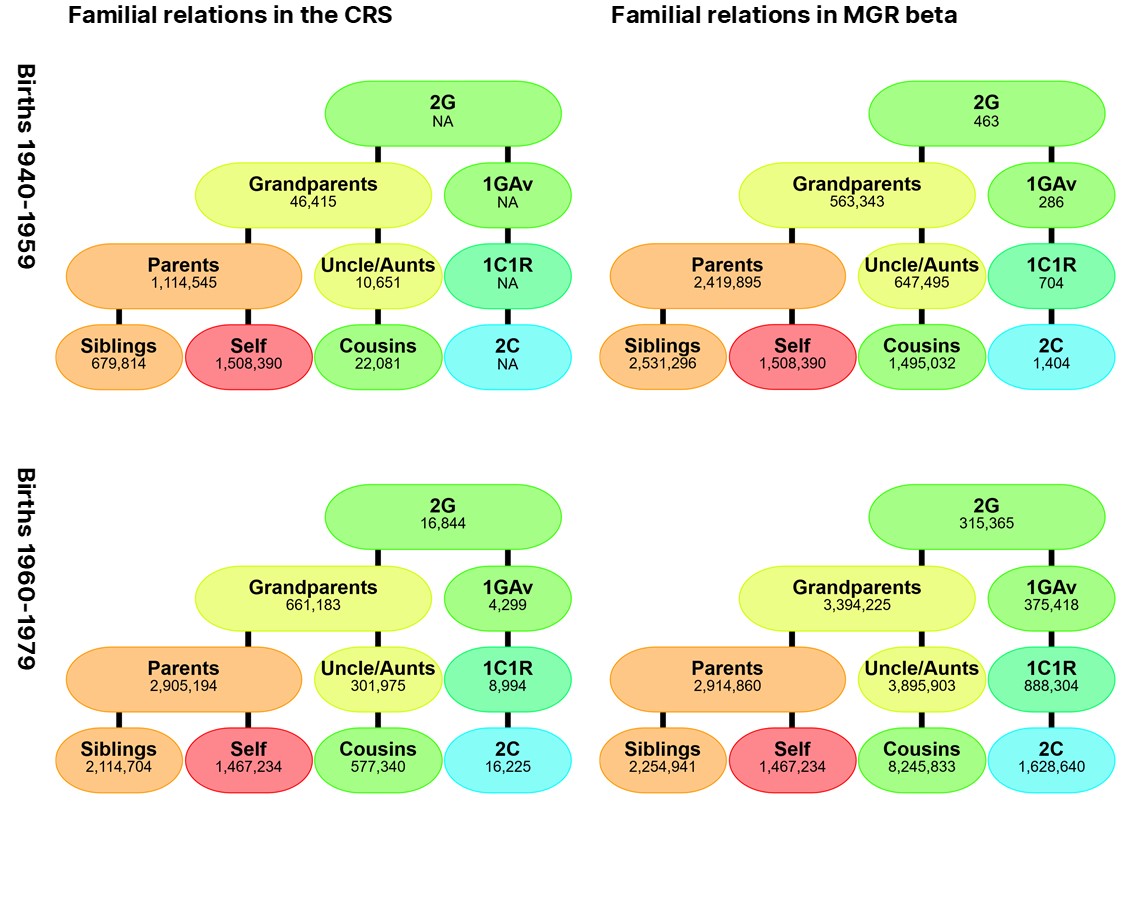

The graphs illustrate the number of family relations identified via the Danish CRS and via the Multi‑Generation Register (MGR beta).
Data for research and statistics
The project is not yet completed, but we have now produced a beta version consisting of the family relations established so far. Researchers can already apply for access to MGR beta through the Danish Data Window, where data can be analysed in a secure environment.
By integrating MGR with Denmark’s unique health, social, and demographic data, researchers can address critical questions about genetic risks, environmental exposures, and societal development—all under strict compliance with data protection legislation.
Why does this matter—nationally and globally?
Denmark’s exceptional population data, now enriched with deep family relations, provide researchers with unique opportunities in epidemiological and social science research. In the long term, MGR beta will contribute to improved public health strategies, the development of personalised medicine, and evidence‑based policymaking – not only in Denmark but internationally.
Collaboration
The Multi‑Generation Register has been developed as a research project in collaboration between the Danish National Archives, the Center for Register-based Research at Aarhus University, and the Department of Computer Science at the University of Copenhagen.
The project is supported by a DKK 38 million grant from the Novo Nordisk Foundation.

Documentation of MGR
View and download the documentation for MGR and MGR beta on the open research platform OSF.

Danish Data Window
Find MGR beta in the Danish Data Window, Statistics Denmark’s application providing easy access to Danish societal data.

Read the news on the Statistics Denmark website
Read Statistics Denmark’s announcement “MGR Beta in foundational data”. (In Danish)