Retired archivists patch gaps in colonial history of U.S. Virgin Islands
Retired archivists patch gaps in colonial history of U.S. Virgin Islands
Records from the Danish colonial period are being digitised in the U.S. Virgin Islands (formerly the Danish West Indies) and are gradually being made available on Arkivalieronline.

Digitisation in the Virgin Islands
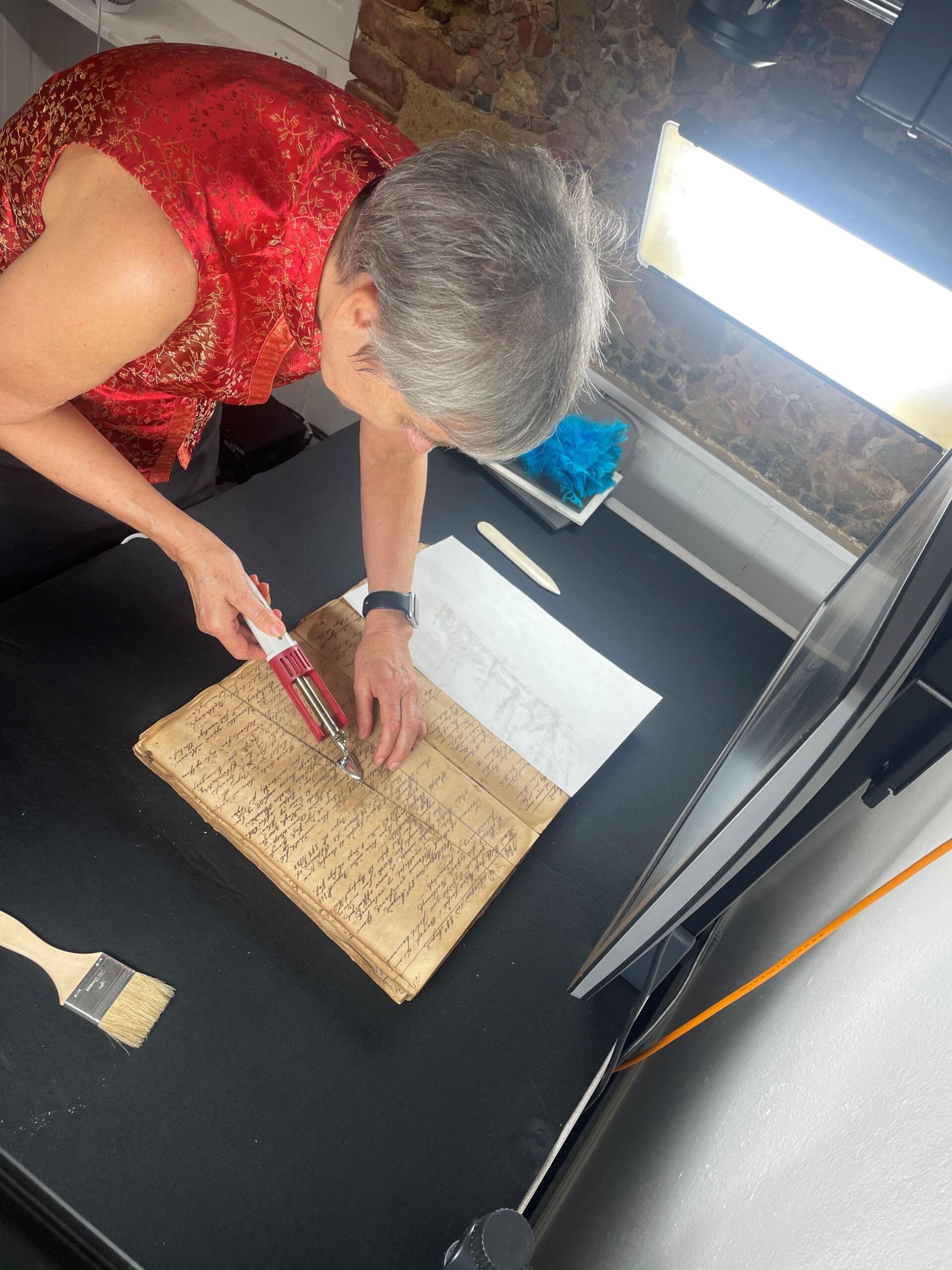
Until 2029, former National Archivist, Asbjørn Hellum and former City Archivist of Aalborg, Ruth Hedegaard, travel twice a year to the U.S. Virgin Islands. Each time, the couple spends about two months digitising the many records from the islands’ time as a Danish colony.
This important work is carried out by agreement and in collaboration with the local government of the U.S. Virgin Islands and is made possible through support from the Civil Engineer Knud Nørgaard and Wife Grethe Nørgaard Foundation (Civilingeniør Knud Nørgaard og hustru Grethe Nørgaards Fond).
Filling gaps in the Danish National Archives’ collections
From 2014 to 2017 – while Asbjørn Hellum was National Archivist in Denmark – the Danish National Archives digitised all records from the local administration in the Danish West Indies that had been transferred to the Archives in Copenhagen before and shortly after Denmark sold the three West Indian islands, St. Thomas, St. Croix and St. John, to the United States in 1917. This material comprises around 800 linear metres of registers, case files and other documents created by the islands’ local Danish authorities during the colonial period.
Records that at the time were still in active use or considered necessary on the islands were not shipped to Copenhagen. As a result, there are gaps in the Danish National Archives’ collections – that is, lacunae in a number of archival series.
Of the records that remained on the islands, some were transferred by the U.S. authorities to the National Archives in Washington, while others stayed in the Virgin Islands. It is these records that Asbjørn Hellum and Ruth Hedegaard are now capturing through digital photography to secure them for the future, and to make it available online.
The records we digitise often fill gaps in the Danish National Archives’ collections. For example, the police court registers from Christiansted for the years 1756–1841 are preserved in the Danish National Archives, while the volumes covering 1841–1917 are kept on St. Thomas.
Race against time and climate
In an article on dr.dk, the couple explain why it is crucial to digitise the records in the Virgin Islands. Read the article on dr.dk (in Danish).
They are up against both time and climate in their efforts to safeguard the archival material. The hot, humid climate and, not least, the many hurricanes that have hit the region have made it difficult to store the fragile documents safely, and some of the records are already so damaged that they can no longer be read or handled.
Digitising USVI History


Records under different authorities
Hellum and Hedegaard’s work is also shaped by the fact that the records are kept in different places and under different custodians. The oldest records preserved in the U.S. Virgin Islands are deeds and mortgage records going back to 1768, held at the Recorder of Deeds Office in Charlotte Amalie and in it’s office in the preserved Government House in Christiansted. Other records are held by the public library and archives service and are stored at several locations across the islands under various authorities.
In addition, a substantial part of the records was transferred in the 1930s and 1950s to the U.S. National Archives, where they remain today. Read more about records relating to the U.S. Virgin Islands held outside the Danish National Archives.
Asbjørn Hellum explains: “These records are unique and document life in a Caribbean slave colony. This gives them great international, and particularly Caribbean, interest and research potential, once they become accessible in ways that support teaching and research in the region. A significant portion of the material documents conditions in the years leading up to the abolition of slavery on the three islands in 1848, and the period thereafter until the sale in 1917.”
The records preserved on the islands are highly distinctive and of great importance. The digitisation project effectively helps to give the population of the U.S. Virgin Islands access to their own history.
New digitised records become part of the Danish National Archives’ digital collections
Digitisation is the first step towards ensuring long-term access to the archival material. Hellum and Hedegaard therefore work closely with the Danish National Archives, which receives and post-processes the image files. The Archives then assumes responsibility for long-term digital preservation and, as far as possible, for providing public access.
Twice a year, Hellum and Hedegaard deliver their image files from the islands to the Danish National Archives. Those parts of the material that do not contain sensitive information on living individuals are published on Arkivalieronline.
Explore the new digitised material
Although the original records are not physically part of the Danish National Archives’ collections, they are gradually being registered in the archival database Daisy and incorporated into the detailed registry:
Use the registry: Sources in the Danish National Archives on the history of the Danish West Indies (U.S. Virgin Island).
See a list of the records that Ruth Hedegaard and Asbjørn Hellum have digitised from 2023 up to the summer of 2025:
Insights into life on the islands
The documents preserved on the islands contain many stories from the colonial period and offer insights into the lives of both the free and the enslaved population.
Naturally, Asbjørn Hellum and Ruth Hedegaard do not have time to read through the records they digitise, but from time to time a line or a sentence will catch their eye and open a life story from the islands.
That was the case when Ruth Hedegaard was digitizing the criminal court register for Christiansted in 1899 and noticed a verdict stating that the convicted woman “ought to lose her neck and have her head placed upon a stake”.
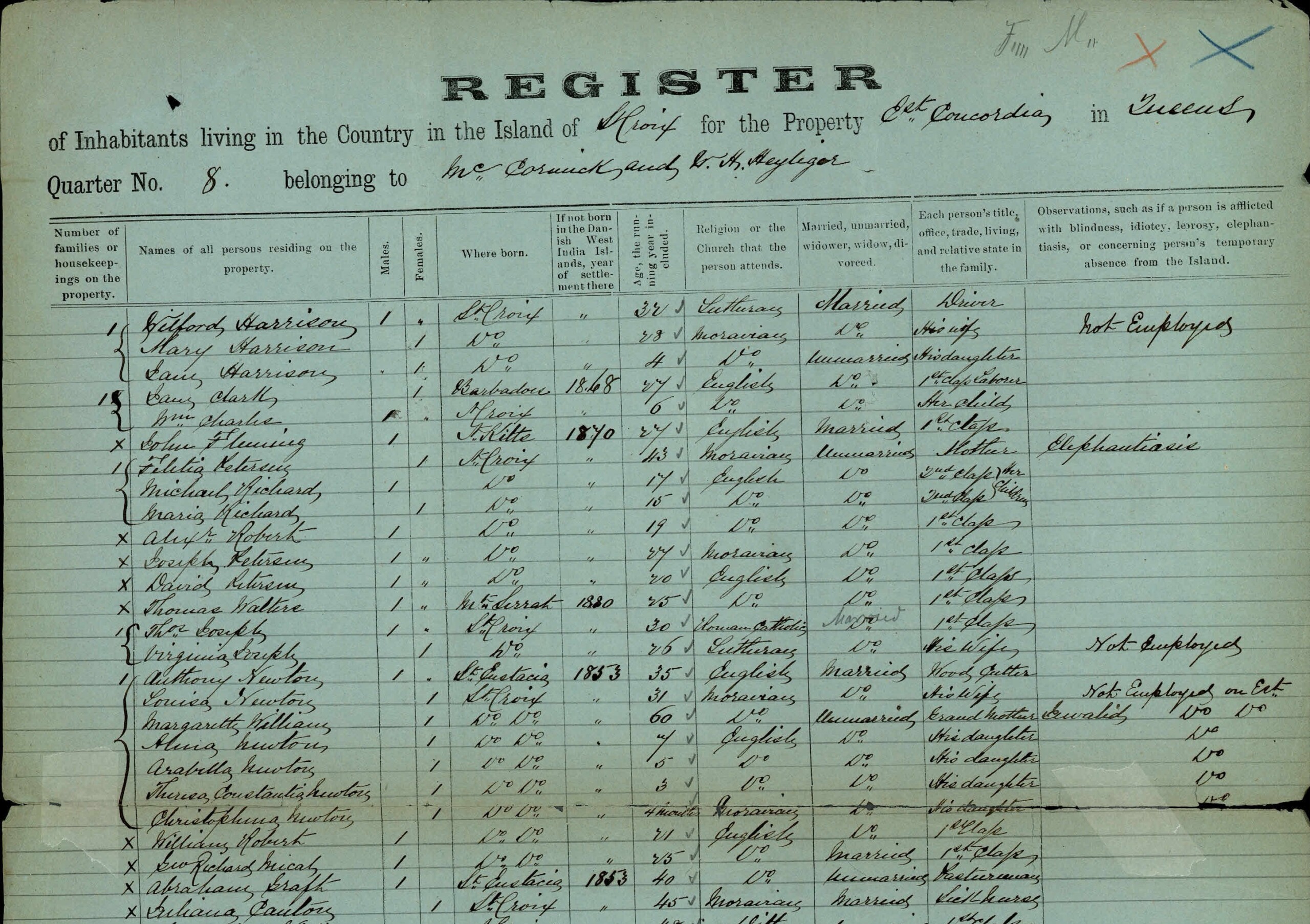
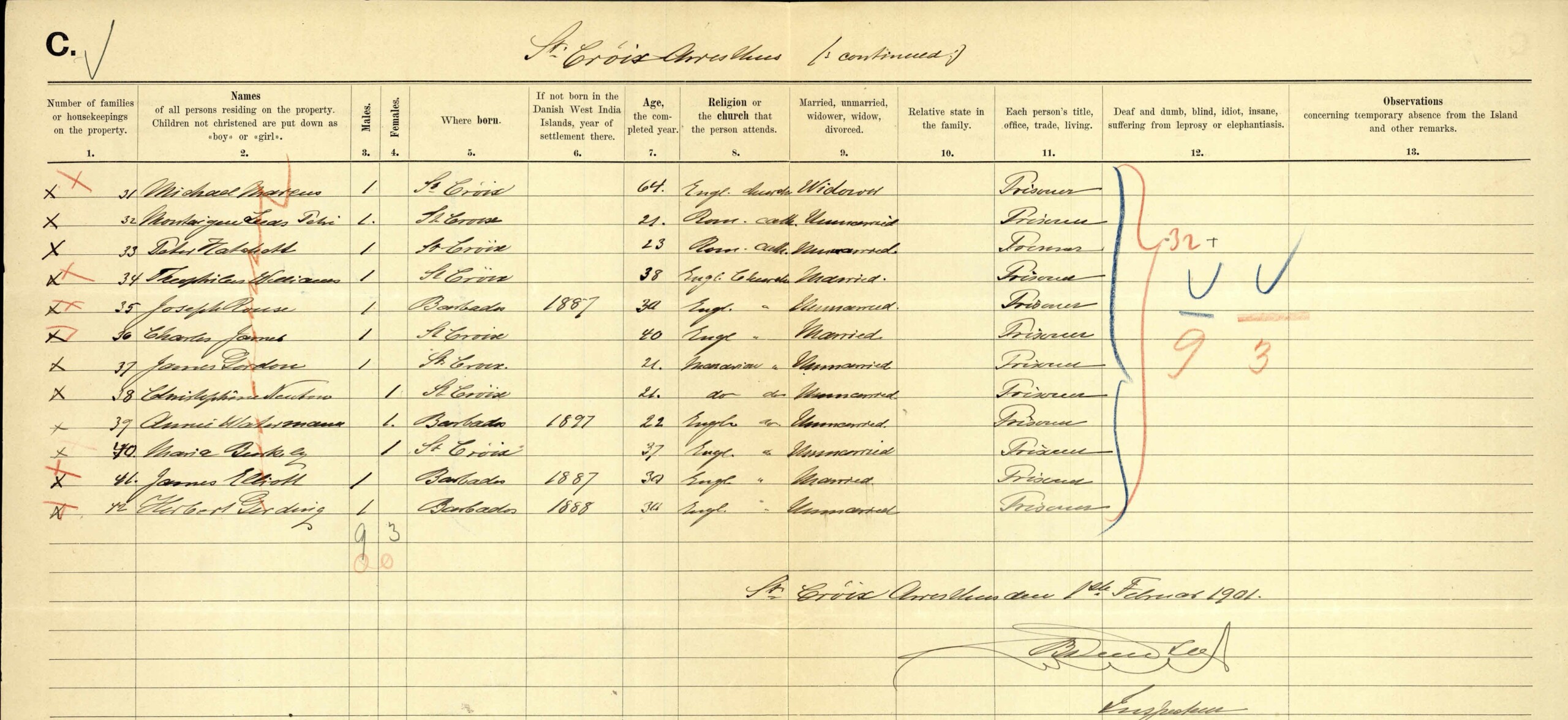
The person in question turned out to be the field labourer Christophine, who had been convicted of poisoning her seven‑week‑old daughter. In the sequence of images below, you can follow Christophine through the records and find out what became of her.
Christophine’s case





Read more

The Danish West Indies
For nearly 250 years The US Virgin Islands was under Danish colonial rule – from the founding of the colony in 1672 to the sale of the islands to the USA in 1917. Uniquely, an enormous amount of descriptions, registers, letters, and illustrations have been preserved in the Danish National Archive, providing a unique insight into history.

Look through the registry
Use the searchable registry of all digitised sources about and from the Danish West Indies. It contains useful comments about the materials and direct links to each archive series on Arkivalieronline.

Records from USVI on Arkivalieronline
Look through the collection of records from the Danish West Indies on Arkivalieronline.